
Miracles
What is a miracle?
First a miracle is a wonderful unexpected supernatural event attributed to divine intervention. It is a perceptible interruption of the laws of nature It is above, contrary to, and outside nature. It is when the impossible happens. You can personally go a see many of these miracles for yourself.
How do you verify a miracle?
The paradox of human miracle assessment is that the only way to discern whether a phenomenon is supernatural is by having trained rationalists testify that it outstrips their training. Since most wonders admitted by the modern church are medical cures, it consults with doctors. The Vatican has access to a pool of 60 covering all the medical branches.
Lourdes Example:
Lourdes is a town in France where people report unexpected healings, and what makes it such a useful example is that every claim—no matter how hopeful—is put through a long, independent medical review to see whether anything truly extraordinary happened.
The Lourdes International Medical Committee [CMIL], a consultation committee made up of some 20 permanent members, doctors from hospitals all over Europe, meets once a year to examine the more serious dossiers.
Of some 50 cases reported every year, about five are studying at length. The members of CMIL do the work of experts, which consists of analyzing the information contained in the dossiers.
The scientific aspect must be distinguished from the spiritual. The cure must exceed the known laws of the illness' evolution, and the person who has experienced the miracle must also recognize the spiritual meaning of the event.
For the cure to be recognized as a miracle, it must fulfill seven criteria established in the 1700s by Pope Benedict XIV.
-
It is necessary to verify the existence of the illness,
-
Which must be serious,
-
With an irrevocable prognosis. (All treatments failed)
-
The illness must be organic or caused by injuries.
-
There must be no treatment at the root of the cure.
-
The latter must be sudden and instantaneous.
-
Finally, the renewal of functions must be total and lasting, without convalescence.
For this reason, the recognition of a miracle takes several years. Once we have recognized it, the cure is published by the bishop of the diocese where the person resides who experienced the miracle.
For example, Leukemia remissions are not considered until they have lasted a decade. A cure attributable to human effort, however, prayed for, is insufficient. "Sometimes we have cases that you could call exceptional, but that's not enough." "Exceptional doesn't mean inexplicable."
The Vatican’s Miracle‑Verification Process
The Vatican’s Miracle‑Verification Process (Step‑by‑Step)
1. A Claim Is Reported
A supposed miracle — almost always a medically inexplicable healing — is first reported to the local bishop. He gathers testimony, medical records, and documentation.
2. Local Investigation
The bishop opens a formal inquiry:
-
Interviews witnesses
-
Collects all medical data
-
Ensures the healing followed prayers directed to a specific holy person (usually someone being considered for sainthood)
If the evidence looks credible, the case is sent to Rome.
3. The Vatican’s Medical Panel (The “Consulta Medica”)
This is where the process becomes surprisingly scientific. The Vatican employs independent medical experts — often non‑Catholics — to evaluate whether:
-
The healing was instantaneous
-
The healing was complete and lasting
-
There is no natural, scientific, or medical explanation
If the doctors conclude the event is medically inexplicable, the case moves forward.
4. The Theological Commission
Theologians then examine whether:
-
The healing resulted specifically from prayers to the candidate
-
The event aligns with Catholic teaching on miracles
They must determine that the event is not just unexplained, but a sign of divine intervention connected to the person’s intercession.
5. Review by Cardinals and the Pope
A panel of cardinals reviews the findings. If they approve, the case goes to the Pope, who makes the final decision to declare the event an official miracle.
Across Eucharistic miracles, Marian apparitions, and the lives of the saints, a consistent story emerges—one in which Catholic claims aren’t just believed but repeatedly witnessed, tested, and historically recorded.
Our Lady of Guadalupe

Our Lady of Guadalupe is one of the most revered Marian apparitions in Catholicism, symbolizing faith, protection, and Mexican identity. Here's a structured overview:
Historical Background
Date and Location: Appeared in 1531 on Tepeyac Hill near Mexico City (then Tenochtitlán) to Juan Diego Cuauhtlatoatzin, an indigenous Aztec convert.
Context: Occurred shortly after the Spanish conquest of the Aztec Empire (1521), blending indigenous and Christian elements during evangelization.
Key Events:
December 9: Virgin Mary appears to Juan Diego, requests a church be built.
December 10: Bishop Juan de Zumárraga demands proof; roses bloom impossibly on the hill in winter.
December 12: Juan Diego presents his tilma (cloak) with the Virgin's image to the bishop, convincing him.
The Miraculous Image
Description: The tilma shows the Virgin as a young mestiza woman with dark skin, standing on a crescent moon, rays of sunlight behind her, and an angel supporting her. Symbols include stars on her mantle (matching 1531 sky), a black sash (indicating pregnancy), and Castilian roses (native to Europe).
Scientific Studies:
Tilma made of cactus fiber, expected to last 20 years but preserved 490+ years despite exposure.
NASA's 1979 infrared analysis: No underdrawing or brush strokes; image floats on fibers.
Eyes reflect scene with 13 figures (including Juan Diego and bishop), discovered via magnification.
Temperature stable at 36.5–37°C (human body temp), resists humidity/pollutants.
Location: Housed in the Basilica of Our Lady of Guadalupe, visited by 20+ million pilgrims yearly.
Significance and Impact
Evangelization: Led to 8–9 million indigenous conversions in a decade, called "the Aztec Madonna."
Cultural Symbol: Patroness of Mexico, the Americas, unborn children, and immigrants. Declared "Patroness of the Americas" by Pope Pius XII (1945).
Feast Day: December 12, national holiday in Mexico with massive celebrations.
Modern Recognition: Pope John Paul II canonized Juan Diego (2002); image linked to tilma's incorruptibility.
Key Facts
Aspect Details
Patronages Mexico, Americas, converts, unborn, families
Shrines Basilica in Mexico City (new and old); replicas worldwide
Miracles Tilma preservation, Castilian roses, human figures in eyes
Papal Visits John Paul II (1979, 1990, 1999, 2002); Francis (2016)
Eucharistic Miracles
Eucharistic miracles are extraordinary events in Catholic tradition where the consecrated Eucharist (bread and/or wine believed to become the Body and Blood of Christ) exhibits visible, physical changes that appear supernatural, such as transforming into human flesh or bleeding. These are distinct from the central miracle of transubstantiation that occurs at every Mass, where the substance changes while appearances remain ordinary.
The Catholic Church investigates such claims carefully, often involving scientific analysis, before deeming them worthy of belief. They serve to strengthen faith in the Real Presence of Christ in the Eucharist. Blessed Carlo Acutis compiled a well-known exhibition and website documenting over 130 such events worldwide.
Here are some of the most famous and frequently cited examples:
1. **Lanciano, Italy (c. 750 AD)**
A doubting priest saw the host turn into flesh and the wine into blood during Mass. The relics—preserved heart tissue and clotted blood—have been studied multiple times, including in the 1970s–1980s, identifying them as human cardiac tissue (myocardium) and type AB blood, with no natural explanation for preservation over centuries.


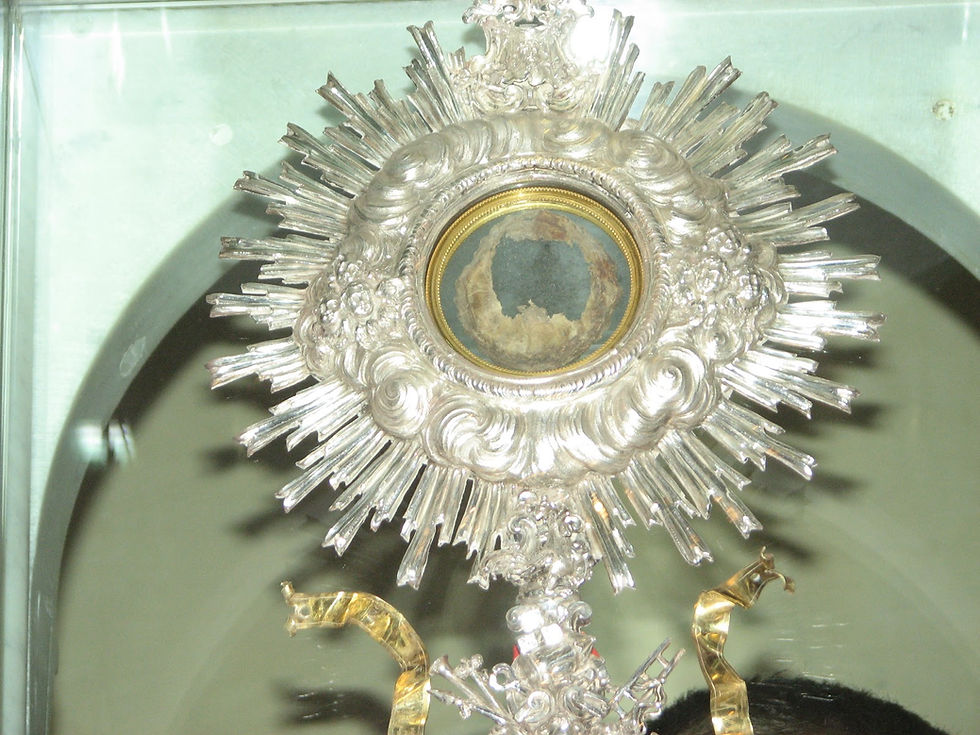
Buenos Aires, Argentina (1992–1996) Multiple incidents involved dropped hosts developing reddish stains. Then-Archbishop Jorge Bergoglio (later Pope Francis) ordered investigations. Scientific exams (including by pathologists) reportedly found human heart tissue from a stressed or inflamed heart, interwoven with bread fibers, and AB blood type. These cases have been highlighted in recent discussions for their modern forensic scrutiny.


Sokółka, Poland (2008) A dropped host placed in water developed a red stain. After Church approval and scientific study, analyses concluded it contained human myocardial tissue integrated with bread in an impossible natural way, again with characteristics of heart tissue from a person in distress.


Fatima

The **Miracles of Fatima** refer primarily to the series of events surrounding the apparitions of the Blessed Virgin Mary to three young shepherd children—Lúcia dos Santos (age 10), Francisco Marto (age 9), and Jacinta Marto (age 7)—in Fátima, Portugal, from May to October 1917. These are among the most famous Marian apparitions in Catholic history, approved by the Church in 1930.
The apparitions began on **May 13, 1917**, when the children reported seeing a beautiful lady "more brilliant than the sun" atop a small holm oak tree in the Cova da Iria. She identified herself as Our Lady of the Rosary (or Our Lady of Fátima) and appeared to them on the 13th of each subsequent month. Her messages emphasized:
- Daily recitation of the Rosary for world peace and the end of World War I.
- Reparation for sins through prayer and sacrifice.
- Devotion to her **Immaculate Heart**.
- Warnings about sin, hell, and future events (including the rise of communism and World War II).
She entrusted the children with **three secrets** (revealed later):
1. A vision of hell and the need for devotion to save souls.
2. A prophecy of the end of WWI, the start of WWII if people did not convert, and a request to consecrate Russia to her Immaculate Heart.
3. A vision interpreted as relating to the persecution of the Church and an assassination attempt on a pope (revealed in 2000 by the Vatican, often linked to the 1981 attempt on Pope John Paul II).
The culminating event is the **Miracle of the Sun** on **October 13, 1917**, which Mary had foretold three months earlier as a sign so that all would believe.
Despite pouring rain and mud, an estimated 30,000–100,000 people (commonly cited as ~70,000) gathered in the field. Witnesses, including believers, skeptics, journalists from anti-clerical newspapers (like *O Século*), and atheists, reported extraordinary phenomena after the children's final apparition:
- The rain suddenly stopped, clouds parted.
- The sun appeared as a spinning, multicolored disk (emitting reds, blues, yellows).
- It "danced" or zigzagged across the sky.
- It seemed to plunge toward the Earth (causing panic, with many thinking the world was ending).
- Then it returned to normal.
The event lasted about 10 minutes. Remarkably, soaked clothes and the muddy ground dried instantly afterward. Eyewitness accounts were consistent across distances (some reported seeing it from miles away), and secular press coverage helped spread the story worldwide.
The Catholic Church investigated thoroughly, deeming the apparitions and miracle worthy of belief. Francisco and Jacinta died young (from the 1918 flu pandemic), and Lúcia became a Carmelite nun, living until 2005 and writing memoirs confirming the events.
Skeptics propose natural explanations like mass hallucination, optical illusions from staring at the sun (afterimages, retinal effects), or atmospheric phenomena (e.g., sundogs or parhelia). However, proponents note the predictions, consistency of thousands of accounts (including non-believers), drying miracle, lack of reported eye damage from direct sun-gazing, and no astronomical observatories recording global solar anomalies—suggesting a localized supernatural event.
Other reported miracles at Fátima include healings (physical and spiritual) during and after the apparitions, some linked to the site's earth or water, and ongoing pilgrimages where many claim graces.
Fátima remains a major pilgrimage site, inspiring devotion to the Rosary and Mary's messages of peace and conversion.


Lourdes

The Miracles of Lourdes** center on the apparitions of the Blessed Virgin Mary to **St. Bernadette Soubirous, a 14-year-old peasant girl, in 1858 at the Grotto of Massabielle in Lourdes, France. These are among the most renowned Marian apparitions in Catholic history, officially recognized by the Church in 1862.
From February 11 to July 16, 1858, Mary appeared to Bernadette 18 times. She described the Lady as a beautiful young woman dressed in white with a blue sash, a golden rose on each foot, holding a rosary, and standing in a niche in the grotto. Key messages included:
- Calls to prayer, penance, and conversion.
- Instructions to **dig in the mud** near the grotto, where a spring of clear water miraculously emerged (initially muddy, it soon flowed abundantly and continues to produce tens of thousands of gallons daily).
- A request to build a **chapel** (now the grand sanctuary).
- On March 25, during the 16th apparition, when Bernadette asked her name, the Lady replied in the local dialect: **"Que soy era Immaculada Concepciou"** ("I am the Immaculate Conception")—affirming the dogma proclaimed by Pope Pius IX just four years earlier in 1854.
During the apparitions, Bernadette faced skepticism, mockery, and investigations from civil authorities and the Church. One notable moment was the "miracle of the candle" on April 7, when she held a burning candle flame to her hand without pain or injury, witnessed by a doctor.
The apparitions led to immediate healings, with the first occurring on March 1, 1858, when Catherine Latapie dipped her paralyzed hand in the new spring and regained full use. This sparked devotion to the waters for physical and spiritual healing.
The Sanctuary of Our Lady of Lourdes has become one of the world's top pilgrimage sites, attracting millions annually. Pilgrims bathe in or drink from the spring, participate in processions, and pray at the grotto.
Healings and recognized miracles: Thousands of cures have been reported (over 7,000 documented), but the **Lourdes Medical Bureau** (established 1905) rigorously investigates claims with input from doctors (believers and non-believers). A cure must be:
- Instantaneous or very rapid.
- Complete and lasting.
- Scientifically inexplicable after exhaustive medical review.
As of recent updates, **72 cases** have been officially recognized as miraculous by the Church (up from 70 in earlier years, with the 72nd being Antonietta Raco's healing from primary lateral sclerosis in 2009, confirmed in 2025).
Skeptics sometimes attribute healings to psychosomatic factors or natural remission, but the Medical Bureau's strict, multi-disciplinary process (often spanning years) aims to rule out such explanations. Proponents see the site as a powerful sign of Mary's intercession and God's mercy.
For more, visit the official sanctuary site at lourdes-france.org.


